Overview
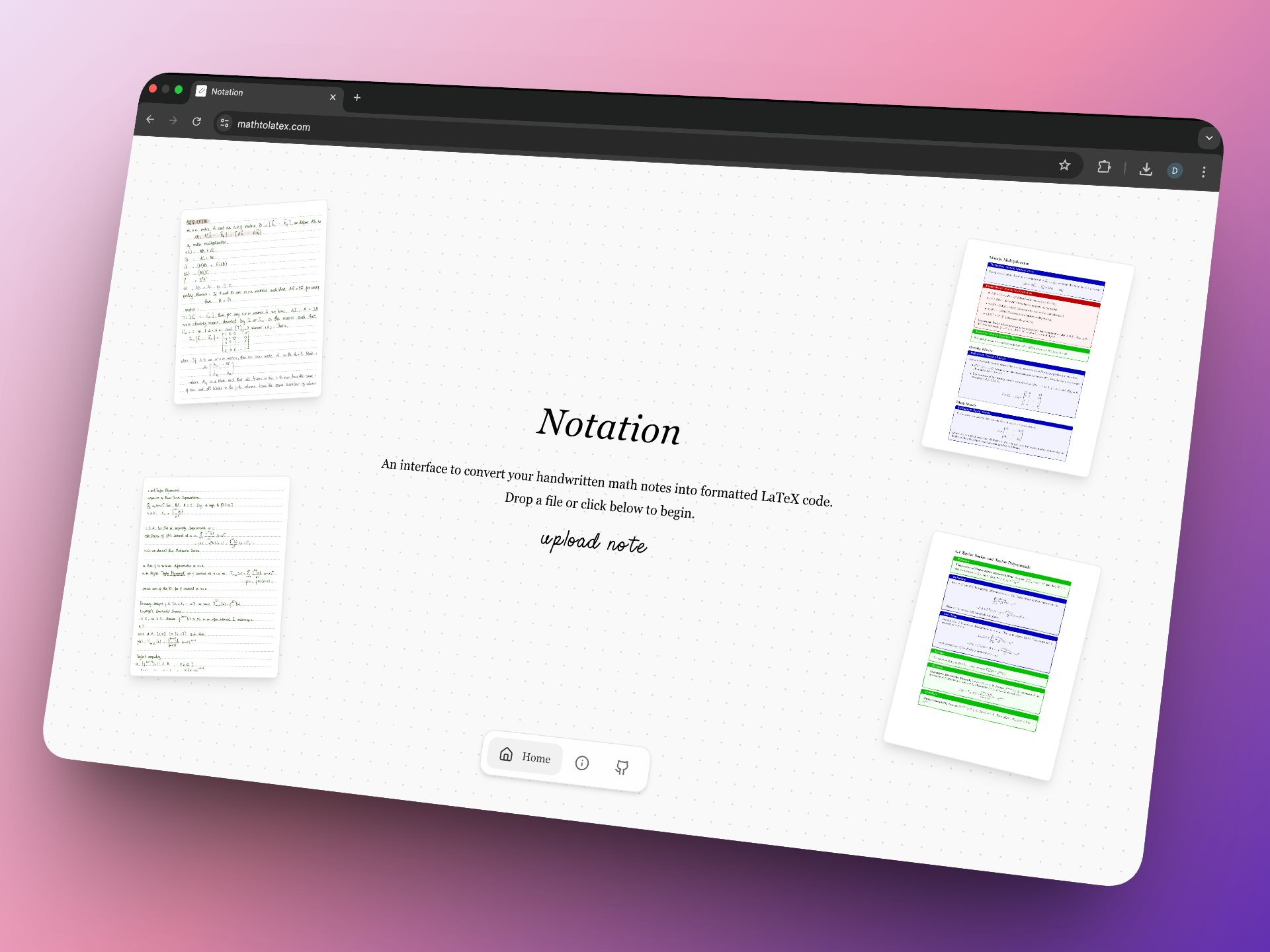
We built Notation to help users convert scanned documents and images into editable LaTeX. Whether it's mathematical equations, technical papers, or complex formulas, Notation uses AI to intelligently extract content and format it as clean, compilable LaTeX code.
Architecture
The system is split into two main components: a Ruby on Rails API backend and a React frontend built with Vite. The backend handles file processing and LaTeX compilation, while the frontend provides the user interface with real-time rendering using KaTeX and react-pdf.

Content Processing Pipeline
When a user uploads a file, the backend determines the MIME type and routes it to the appropriate extraction service: PdfToLatexService for PDFs or ImageToLatexService for images. Both services leverage Google's Gemini 2.5 Flash model for content extraction.
def extract_content(file, mime_type)
  case mime_type
  when /pdf/
    PdfToLatexService.new(file).convert
  when /image/
    ImageToLatexService.new(file).convert
  else
    raise "Unsupported file type"
  end
end
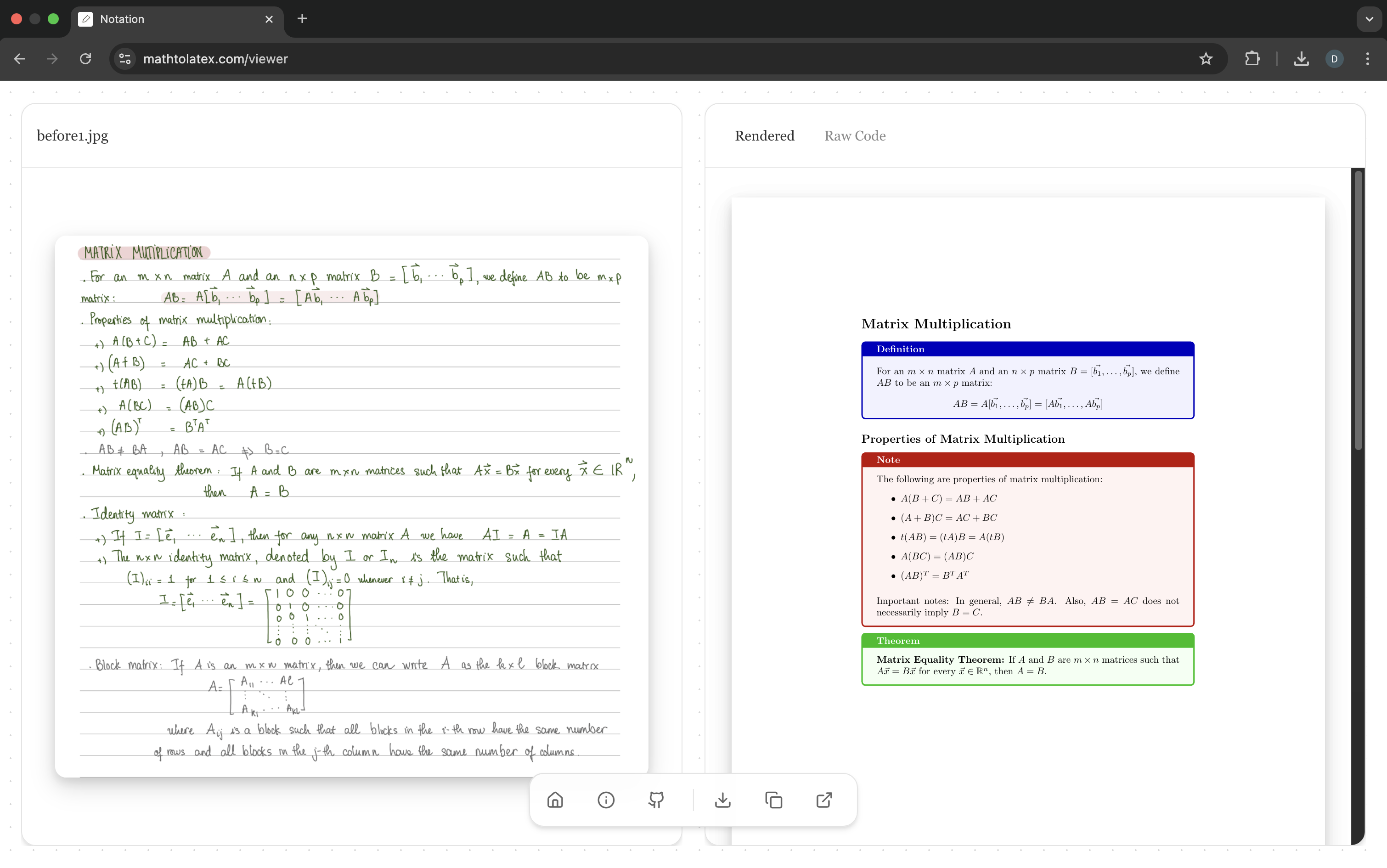
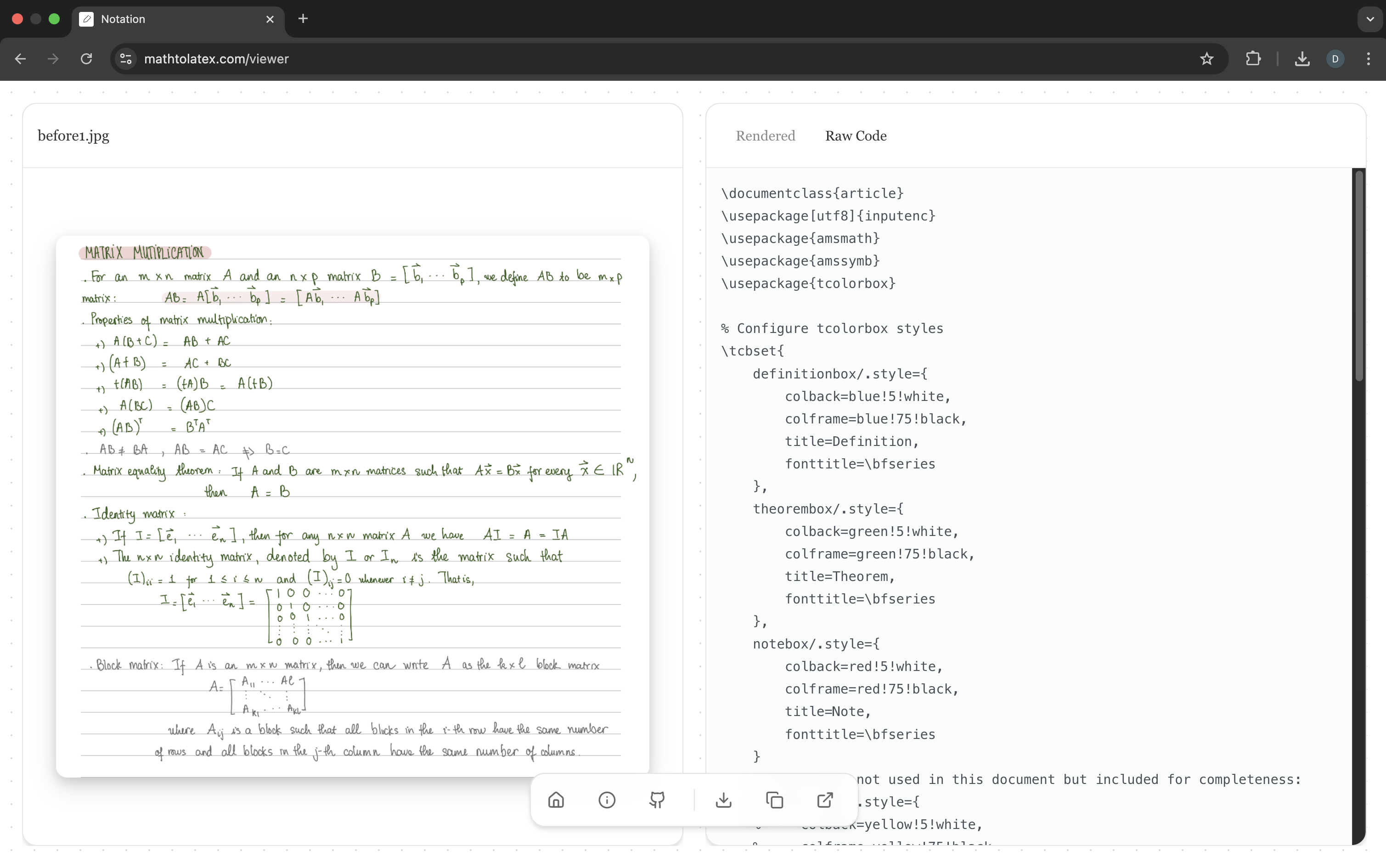
After extraction, the ContentFormattingService processes the raw output to ensure proper LaTeX formatting. The tcolorbox package is used to format notes into visually appealing color-coded boxes.
The compilation endpoint takes LaTeX code and generates a PDF using the LatexCompilationService. We implemented real-time compilation so users can see their documents rendered immediately after extraction. The frontend automatically strips markdown code block markers before sending to the compiler.
Frontend
The React frontend features a dual-pane interface with two tabs: 'Rendered' and 'Raw Code'. Users can toggle between viewing the compiled PDF and inspecting the raw LaTeX source. We used react-pdf for PDF rendering with responsive sizing, and Framer Motion for smooth transitions between states.
Deployment
We deployed Notation on Google Cloud Platform using Cloud Run for serverless scaling. The project includes a complete CI/CD pipeline with Google Cloud Build, automatically building and deploying both frontend and backend containers. Docker Compose is available for local development.